
Massive Landslide Turns Routine Journey into a Catastrophe
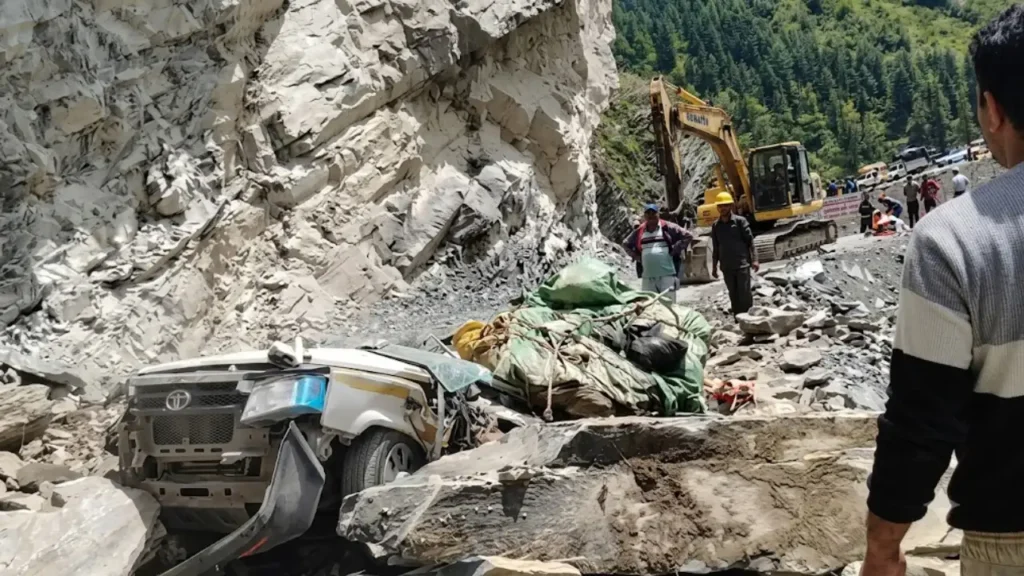
A devastating landslide in Himachal Pradesh’s Lahaul and Spiti district claimed the lives of 13 people after a passenger taxi was crushed under massive rocks, mud, and debris on the Udaipur–Killar highway. The tragic incident occurred near the landslide-prone Kadu Nala stretch, transforming what had begun as a routine journey into one of the deadliest road accidents in the region this monsoon season.
The taxi, reportedly carrying 13 occupants, was travelling from Kullu towards the remote Pangi Valley when a section of the mountain slope suddenly collapsed. Within moments, tons of rocks and earth engulfed the vehicle, leaving little chance for those inside to escape.
The incident has once again highlighted the dangers associated with travelling through the fragile Himalayan terrain during periods of intense rainfall, when landslides and rockfalls become increasingly frequent.

Highway Reopened Only Hours Before the Fatal Incident
According to local authorities, the Udaipur–Killar road had remained closed on Thursday after continuous rainfall triggered multiple landslides across the region. The Border Roads Organisation (BRO), responsible for maintaining the strategically important highway, carried out clearance operations before reopening the route for traffic on Friday morning.
Passengers travelling towards Pangi Valley, including those aboard the ill-fated taxi, had reportedly spent the night at Tindi while waiting for the road to become operational.
Soon after traffic resumed, the taxi proceeded towards Kadu Nala, a stretch known for frequent rockfalls. It was here that another landslide struck without warning. A large section of the hillside collapsed, sending boulders, loose rocks and mud crashing directly onto the moving vehicle.
Witnesses described the incident as sudden and devastating, leaving virtually no time for the driver or passengers to react.
Rescue Teams Rush to the Scene
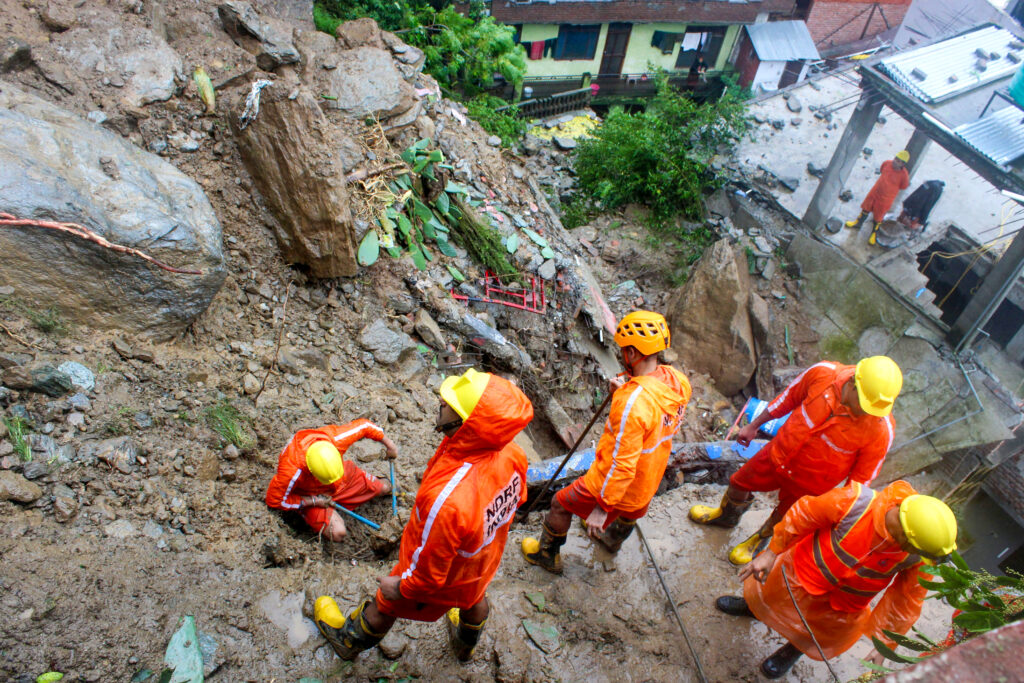
Emergency response teams from the Tindi Police Station, the Lahaul-Spiti district administration, and local disaster response units immediately rushed to the accident site after receiving information about the landslide.
Heavy earthmoving equipment, including excavators and other machinery, was deployed to remove the enormous volume of debris covering the taxi. Rescue workers faced extremely difficult conditions as intermittent rainfall, unstable mountain slopes, and loose rocks continued to threaten operations.
Authorities initially launched an intensive search-and-rescue mission in the hope of locating survivors. However, the scale of the landslide and the extent of damage to the vehicle made rescue efforts particularly challenging.
Officials worked continuously to recover victims from beneath the debris while ensuring the safety of rescue personnel operating in hazardous conditions.
Challenging Weather Complicates Rescue Operations
The rescue mission was significantly affected by persistent rainfall across the district. Heavy rain continued to loosen rocks and destabilize slopes, creating the risk of additional landslides during the operation.
Emergency teams had to proceed cautiously while clearing debris, as secondary collapses remained a constant threat.
Officials described the operation as a race against time, balancing the urgent need to reach the buried vehicle with the safety of rescue workers.
Mountain rescue operations in high-altitude regions are often slowed by narrow roads, limited equipment access, unstable terrain, and rapidly changing weather conditions. The difficult topography of the Lahaul-Spiti region further complicated efforts throughout the day.
Authorities Issue Fresh Travel Advisory
Following the tragedy, district authorities urged residents and tourists to avoid non-essential travel on landslide-prone roads until weather conditions improve.
Pangi Resident Commissioner Amandeep Singh advised commuters to postpone unnecessary journeys through vulnerable mountain corridors and to follow official advisories before travelling.
Authorities stressed that road reopening after debris clearance does not completely eliminate the possibility of fresh landslides, particularly during periods of continuous rainfall when mountain slopes remain saturated and unstable.
Travellers have been encouraged to monitor weather forecasts, road status updates, and official notifications issued by local administration before planning journeys in the region.
A Lifeline Through Difficult Terrain
The Udaipur–Killar highway serves as a crucial road link connecting remote settlements in Lahaul-Spiti and the Pangi Valley. Every year, thousands of local residents, government employees, transport operators, and tourists depend on the route for access to essential services and supplies.
However, the highway is also regarded as one of Himachal Pradesh’s most challenging mountain roads. Steep cliffs, narrow carriageways, sharp bends, and unstable rock formations make it particularly vulnerable during the monsoon season.
Continuous rainfall weakens mountain slopes, increasing the likelihood of landslides, mudslides, and falling boulders that can occur with little or no warning.
Infrastructure agencies regularly carry out road maintenance and debris clearance, but extreme weather conditions often result in repeated closures throughout the rainy season.

Monsoon Raises Landslide Risk Across Himachal Pradesh
Every year, Himachal Pradesh experiences widespread disruption during the southwest monsoon. Heavy rainfall frequently triggers flash floods, road collapses, cloudbursts, and landslides across several districts, including Lahaul-Spiti, Kullu, Chamba, Mandi, Kangra, and Shimla.
The Himalayan region’s young geological structure, combined with steep gradients and intense rainfall, makes it especially vulnerable to slope failures.
Experts note that prolonged rain allows water to seep deep into mountain slopes, reducing soil stability and increasing the risk of sudden collapses. Even after roads are reopened, unstable sections may continue to pose a threat for several hours or days.
Authorities therefore continue to advise caution, particularly for travellers using remote mountain highways during adverse weather.
Safety Remains a Shared Responsibility
Officials have reiterated the importance of following travel advisories and avoiding unnecessary journeys during periods of heavy rainfall.
Motorists travelling through Himalayan regions are encouraged to:
- Check official road status before departure.
- Avoid travelling during heavy rain or late-night hours.
- Follow instructions issued by local authorities and the Border Roads Organisation.
- Remain alert near known landslide-prone stretches.
- Carry emergency supplies while travelling through remote mountain areas.
Although infrastructure improvements have enhanced connectivity across Himachal Pradesh, unpredictable natural hazards continue to pose significant challenges.
A Tragic Reminder of Nature’s Unpredictability
The landslide near Kadu Nala stands as a heartbreaking reminder of the risks associated with mountain travel during the monsoon season. What began as a long-awaited journey after the reopening of the highway ended in unimaginable tragedy for the passengers and their families.
The incident has once again underscored the need for continued investment in slope stabilization, early warning systems, improved weather monitoring, and rapid emergency response mechanisms across vulnerable Himalayan highways.
As rescue teams complete recovery operations and authorities assess the circumstances surrounding the disaster, the focus remains on supporting the affected families while reinforcing road safety measures in one of India’s most challenging mountain landscapes.
The Lahaul-Spiti tragedy serves as a solemn reminder that despite advances in road infrastructure and emergency response capabilities, the immense power of nature continues to demand caution, preparedness, and respect from everyone travelling through the fragile Himalayan region.
Massive Landslide Turns Routine Journey into a Catastrophe
A devastating landslide in Himachal Pradesh’s Lahaul and Spiti district claimed the lives of 13 people after a passenger taxi was crushed under massive rocks, mud, and debris on the Udaipur–Killar highway. The tragic incident occurred near the landslide-prone Kadu Nala stretch, transforming what had begun as a routine journey into one of the deadliest road accidents in the region this monsoon season.
The taxi, reportedly carrying 13 occupants, was travelling from Kullu towards the remote Pangi Valley when a section of the mountain slope suddenly collapsed. Within moments, tons of rocks and earth engulfed the vehicle, leaving little chance for those inside to escape.
The incident has once again highlighted the dangers associated with travelling through the fragile Himalayan terrain during periods of intense rainfall, when landslides and rockfalls become increasingly frequent.
Highway Reopened Only Hours Before the Fatal Incident
According to local authorities, the Udaipur–Killar road had remained closed on Thursday after continuous rainfall triggered multiple landslides across the region. The Border Roads Organisation (BRO), responsible for maintaining the strategically important highway, carried out clearance operations before reopening the route for traffic on Friday morning.
Passengers travelling towards Pangi Valley, including those aboard the ill-fated taxi, had reportedly spent the night at Tindi while waiting for the road to become operational.
Soon after traffic resumed, the taxi proceeded towards Kadu Nala, a stretch known for frequent rockfalls. It was here that another landslide struck without warning. A large section of the hillside collapsed, sending boulders, loose rocks and mud crashing directly onto the moving vehicle.
Witnesses described the incident as sudden and devastating, leaving virtually no time for the driver or passengers to react.
Rescue Teams Rush to the Scene
Emergency response teams from the Tindi Police Station, the Lahaul-Spiti district administration, and local disaster response units immediately rushed to the accident site after receiving information about the landslide.
Heavy earthmoving equipment, including excavators and other machinery, was deployed to remove the enormous volume of debris covering the taxi. Rescue workers faced extremely difficult conditions as intermittent rainfall, unstable mountain slopes, and loose rocks continued to threaten operations.
Authorities initially launched an intensive search-and-rescue mission in the hope of locating survivors. However, the scale of the landslide and the extent of damage to the vehicle made rescue efforts particularly challenging.
Officials worked continuously to recover victims from beneath the debris while ensuring the safety of rescue personnel operating in hazardous conditions.
Challenging Weather Complicates Rescue Operations
The rescue mission was significantly affected by persistent rainfall across the district. Heavy rain continued to loosen rocks and destabilize slopes, creating the risk of additional landslides during the operation.
Emergency teams had to proceed cautiously while clearing debris, as secondary collapses remained a constant threat.
Officials described the operation as a race against time, balancing the urgent need to reach the buried vehicle with the safety of rescue workers.
Mountain rescue operations in high-altitude regions are often slowed by narrow roads, limited equipment access, unstable terrain, and rapidly changing weather conditions. The difficult topography of the Lahaul-Spiti region further complicated efforts throughout the day.
Authorities Issue Fresh Travel Advisory
Following the tragedy, district authorities urged residents and tourists to avoid non-essential travel on landslide-prone roads until weather conditions improve.
Pangi Resident Commissioner Amandeep Singh advised commuters to postpone unnecessary journeys through vulnerable mountain corridors and to follow official advisories before travelling.
Authorities stressed that road reopening after debris clearance does not completely eliminate the possibility of fresh landslides, particularly during periods of continuous rainfall when mountain slopes remain saturated and unstable.
Travellers have been encouraged to monitor weather forecasts, road status updates, and official notifications issued by local administration before planning journeys in the region.
A Lifeline Through Difficult Terrain
The Udaipur–Killar highway serves as a crucial road link connecting remote settlements in Lahaul-Spiti and the Pangi Valley. Every year, thousands of local residents, government employees, transport operators, and tourists depend on the route for access to essential services and supplies.
However, the highway is also regarded as one of Himachal Pradesh’s most challenging mountain roads. Steep cliffs, narrow carriageways, sharp bends, and unstable rock formations make it particularly vulnerable during the monsoon season.
Continuous rainfall weakens mountain slopes, increasing the likelihood of landslides, mudslides, and falling boulders that can occur with little or no warning.
Infrastructure agencies regularly carry out road maintenance and debris clearance, but extreme weather conditions often result in repeated closures throughout the rainy season.
Monsoon Raises Landslide Risk Across Himachal Pradesh
Every year, Himachal Pradesh experiences widespread disruption during the southwest monsoon. Heavy rainfall frequently triggers flash floods, road collapses, cloudbursts, and landslides across several districts, including Lahaul-Spiti, Kullu, Chamba, Mandi, Kangra, and Shimla.
The Himalayan region’s young geological structure, combined with steep gradients and intense rainfall, makes it especially vulnerable to slope failures.
Experts note that prolonged rain allows water to seep deep into mountain slopes, reducing soil stability and increasing the risk of sudden collapses. Even after roads are reopened, unstable sections may continue to pose a threat for several hours or days.
Authorities therefore continue to advise caution, particularly for travellers using remote mountain highways during adverse weather.
Safety Remains a Shared Responsibility
Officials have reiterated the importance of following travel advisories and avoiding unnecessary journeys during periods of heavy rainfall.
Motorists travelling through Himalayan regions are encouraged to:
- Check official road status before departure.
- Avoid travelling during heavy rain or late-night hours.
- Follow instructions issued by local authorities and the Border Roads Organisation.
- Remain alert near known landslide-prone stretches.
- Carry emergency supplies while travelling through remote mountain areas.
Although infrastructure improvements have enhanced connectivity across Himachal Pradesh, unpredictable natural hazards continue to pose significant challenges.
A Tragic Reminder of Nature’s Unpredictability
The landslide near Kadu Nala stands as a heartbreaking reminder of the risks associated with mountain travel during the monsoon season. What began as a long-awaited journey after the reopening of the highway ended in unimaginable tragedy for the passengers and their families.
The incident has once again underscored the need for continued investment in slope stabilization, early warning systems, improved weather monitoring, and rapid emergency response mechanisms across vulnerable Himalayan highways.
As rescue teams complete recovery operations and authorities assess the circumstances surrounding the disaster, the focus remains on supporting the affected families while reinforcing road safety measures in one of India’s most challenging mountain landscapes.
The Lahaul-Spiti tragedy serves as a solemn reminder that despite advances in road infrastructure and emergency response capabilities, the immense power of nature continues to demand caution, preparedness, and respect from everyone travelling through the fragile Himalayan region.
Massive Landslide Turns Routine Journey into a Catastrophe
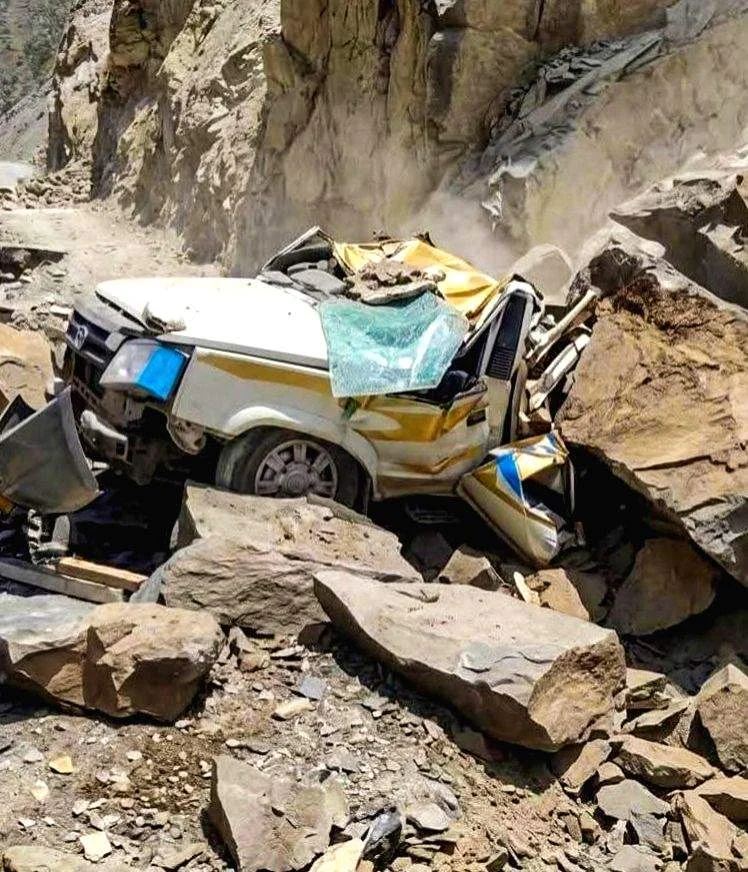
A devastating landslide in Himachal Pradesh’s Lahaul and Spiti district claimed the lives of 13 people after a passenger taxi was crushed under massive rocks, mud, and debris on the Udaipur–Killar highway. The tragic incident occurred near the landslide-prone Kadu Nala stretch, transforming what had begun as a routine journey into one of the deadliest road accidents in the region this monsoon season.
The taxi, reportedly carrying 13 occupants, was travelling from Kullu towards the remote Pangi Valley when a section of the mountain slope suddenly collapsed. Within moments, tons of rocks and earth engulfed the vehicle, leaving little chance for those inside to escape.
The incident has once again highlighted the dangers associated with travelling through the fragile Himalayan terrain during periods of intense rainfall, when landslides and rockfalls become increasingly frequent.
Highway Reopened Only Hours Before the Fatal Incident
According to local authorities, the Udaipur–Killar road had remained closed on Thursday after continuous rainfall triggered multiple landslides across the region. The Border Roads Organisation (BRO), responsible for maintaining the strategically important highway, carried out clearance operations before reopening the route for traffic on Friday morning.
Passengers travelling towards Pangi Valley, including those aboard the ill-fated taxi, had reportedly spent the night at Tindi while waiting for the road to become operational.
Soon after traffic resumed, the taxi proceeded towards Kadu Nala, a stretch known for frequent rockfalls. It was here that another landslide struck without warning. A large section of the hillside collapsed, sending boulders, loose rocks and mud crashing directly onto the moving vehicle.
Witnesses described the incident as sudden and devastating, leaving virtually no time for the driver or passengers to react.
Rescue Teams Rush to the Scene
Emergency response teams from the Tindi Police Station, the Lahaul-Spiti district administration, and local disaster response units immediately rushed to the accident site after receiving information about the landslide.
Heavy earthmoving equipment, including excavators and other machinery, was deployed to remove the enormous volume of debris covering the taxi. Rescue workers faced extremely difficult conditions as intermittent rainfall, unstable mountain slopes, and loose rocks continued to threaten operations.
Authorities initially launched an intensive search-and-rescue mission in the hope of locating survivors. However, the scale of the landslide and the extent of damage to the vehicle made rescue efforts particularly challenging.
Officials worked continuously to recover victims from beneath the debris while ensuring the safety of rescue personnel operating in hazardous conditions.
Challenging Weather Complicates Rescue Operations
The rescue mission was significantly affected by persistent rainfall across the district. Heavy rain continued to loosen rocks and destabilize slopes, creating the risk of additional landslides during the operation.
Emergency teams had to proceed cautiously while clearing debris, as secondary collapses remained a constant threat.
Officials described the operation as a race against time, balancing the urgent need to reach the buried vehicle with the safety of rescue workers.
Mountain rescue operations in high-altitude regions are often slowed by narrow roads, limited equipment access, unstable terrain, and rapidly changing weather conditions. The difficult topography of the Lahaul-Spiti region further complicated efforts throughout the day.
Authorities Issue Fresh Travel Advisory
Following the tragedy, district authorities urged residents and tourists to avoid non-essential travel on landslide-prone roads until weather conditions improve.
Pangi Resident Commissioner Amandeep Singh advised commuters to postpone unnecessary journeys through vulnerable mountain corridors and to follow official advisories before travelling.
Authorities stressed that road reopening after debris clearance does not completely eliminate the possibility of fresh landslides, particularly during periods of continuous rainfall when mountain slopes remain saturated and unstable.
Travellers have been encouraged to monitor weather forecasts, road status updates, and official notifications issued by local administration before planning journeys in the region.
A Lifeline Through Difficult Terrain
The Udaipur–Killar highway serves as a crucial road link connecting remote settlements in Lahaul-Spiti and the Pangi Valley. Every year, thousands of local residents, government employees, transport operators, and tourists depend on the route for access to essential services and supplies.
However, the highway is also regarded as one of Himachal Pradesh’s most challenging mountain roads. Steep cliffs, narrow carriageways, sharp bends, and unstable rock formations make it particularly vulnerable during the monsoon season.
Continuous rainfall weakens mountain slopes, increasing the likelihood of landslides, mudslides, and falling boulders that can occur with little or no warning.
Infrastructure agencies regularly carry out road maintenance and debris clearance, but extreme weather conditions often result in repeated closures throughout the rainy season.

Monsoon Raises Landslide Risk Across Himachal Pradesh
Every year, Himachal Pradesh experiences widespread disruption during the southwest monsoon. Heavy rainfall frequently triggers flash floods, road collapses, cloudbursts, and landslides across several districts, including Lahaul-Spiti, Kullu, Chamba, Mandi, Kangra, and Shimla.
The Himalayan region’s young geological structure, combined with steep gradients and intense rainfall, makes it especially vulnerable to slope failures.
Experts note that prolonged rain allows water to seep deep into mountain slopes, reducing soil stability and increasing the risk of sudden collapses. Even after roads are reopened, unstable sections may continue to pose a threat for several hours or days.
Authorities therefore continue to advise caution, particularly for travellers using remote mountain highways during adverse weather.
Safety Remains a Shared Responsibility
Officials have reiterated the importance of following travel advisories and avoiding unnecessary journeys during periods of heavy rainfall.
Motorists travelling through Himalayan regions are encouraged to:
- Check official road status before departure.
- Avoid travelling during heavy rain or late-night hours.
- Follow instructions issued by local authorities and the Border Roads Organisation.
- Remain alert near known landslide-prone stretches.
- Carry emergency supplies while travelling through remote mountain areas.
Although infrastructure improvements have enhanced connectivity across Himachal Pradesh, unpredictable natural hazards continue to pose significant challenges.
A Tragic Reminder of Nature’s Unpredictability
The landslide near Kadu Nala stands as a heartbreaking reminder of the risks associated with mountain travel during the monsoon season. What began as a long-awaited journey after the reopening of the highway ended in unimaginable tragedy for the passengers and their families.
The incident has once again underscored the need for continued investment in slope stabilization, early warning systems, improved weather monitoring, and rapid emergency response mechanisms across vulnerable Himalayan highways.
As rescue teams complete recovery operations and authorities assess the circumstances surrounding the disaster, the focus remains on supporting the affected families while reinforcing road safety measures in one of India’s most challenging mountain landscapes.
The Lahaul-Spiti tragedy serves as a solemn reminder that despite advances in road infrastructure and emergency response capabilities, the immense power of nature continues to demand caution, preparedness, and respect from everyone travelling through the fragile Himalayan region.
